
Making Information Make Sense
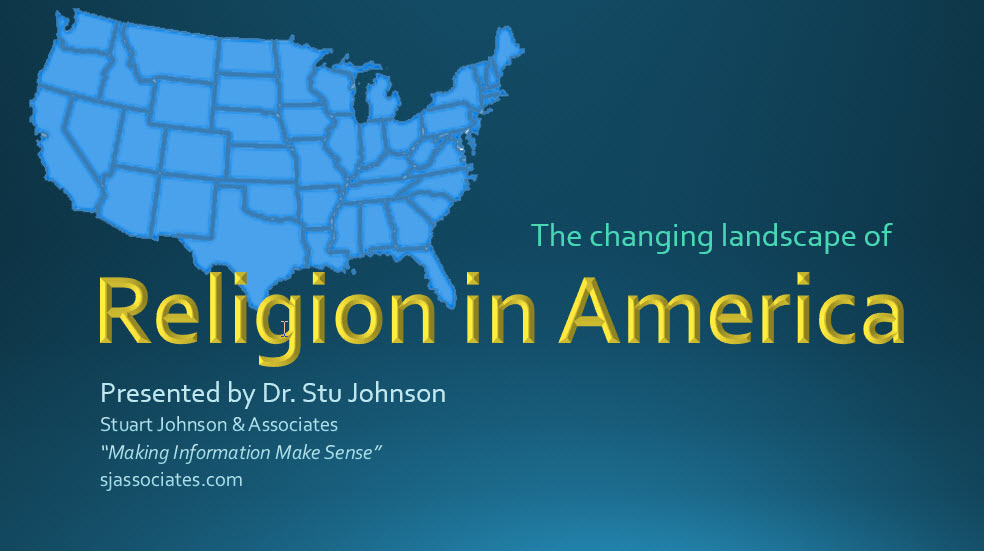 While America remains a very religious country, the decades of the 21st century have seen a changing mix, particularly with the "rise of the nones" (those who claim no religious affiliation, which has been most evident among younger age cohorts). Religion in America traces significant changes, some going back to the end of World War II in 1945, much to the early 1970s, using data from public opinion polls and research by Gallup, Pew, Barna and others. The report is updated throughout the year.
Latest updates:
- Updated Cofidence in Insttituiions for 2022 data (Including NEW Digging Deeper section on Survey Demographics , August 2022
- Updated Summary for 2021 date (January 2022)
- Updated "Digging Deeper" Confidence in Institutions Overview (July 2021), added a second part with trendline charts of responses for each institution (August 2021)
- Updated "Confidence in Religion and Other American Institutions" section (July 2021)
- Added new Digging Deeper pages with additional details and demographics on key topics (June 2021)
On the InfoMatters blog…

COVID-19 Retrospective
May 12

Retrieving requested article...
COVID Perspectives for February
March 10
Retrieving requested article...

We are more thoroughly an enlightened people, with respect to our political interests, than perhaps any other under heaven. Every man among us reads, and is so easy in his circumstances as to have leisure for conversations of improvement and for acquiring information.
While America remains a very religious country, the decades of the 21st century have seen a changing mix, particularly with the "rise of the nones" (those who claim no religious affiliation, which has been most evident among younger age cohorts). Religion in America traces significant changes, some going back to the end of World War II in 1945, much to the early 1970s, using data from public opinion polls and research by Gallup, Pew, Barna and others. The report is updated throughout the year.
Latest updates:
- Updated Cofidence in Insttituiions for 2022 data (Including NEW Digging Deeper section on Survey Demographics , August 2022
- Updated Summary for 2021 date (January 2022)
- Updated "Digging Deeper" Confidence in Institutions Overview (July 2021), added a second part with trendline charts of responses for each institution (August 2021)
- Updated "Confidence in Religion and Other American Institutions" section (July 2021)
- Added new Digging Deeper pages with additional details and demographics on key topics (June 2021)
On the InfoMatters blog…
COVID-19 Retrospective
May 12
Retrieving requested article...
COVID Perspectives for February
March 10
Retrieving requested article...
A library of wisdom, then, is more precious than all wealth, and all things that are desirable cannot be compared to it.
On the InfoMatters blog…
COVID-19 Retrospective
May 12
Retrieving requested article...
COVID Perspectives for February
March 10
Retrieving requested article...
While America remains a very religious country, the decades of the 21st century have seen a changing mix, particularly with the "rise of the nones" (those who claim no religious affiliation, which has been most evident among younger age cohorts). Religion in America traces significant changes, some going back to the end of World War II in 1945, much to the early 1970s, using data from public opinion polls and research by Gallup, Pew, Barna and others. The report is updated throughout the year.
Latest updates:
- Updated Cofidence in Insttituiions for 2022 data (Including NEW Digging Deeper section on Survey Demographics , August 2022
- Updated Summary for 2021 date (January 2022)
- Updated "Digging Deeper" Confidence in Institutions Overview (July 2021), added a second part with trendline charts of responses for each institution (August 2021)
- Updated "Confidence in Religion and Other American Institutions" section (July 2021)
- Added new Digging Deeper pages with additional details and demographics on key topics (June 2021)
Hard-covered books break up friendships. You loan a hard covered book to a friend and when he doesn't return it you get mad at him. It makes you mean and petty. But twenty-five cent books are different.